Training Tip: Must-Have Obstacles: Staircase
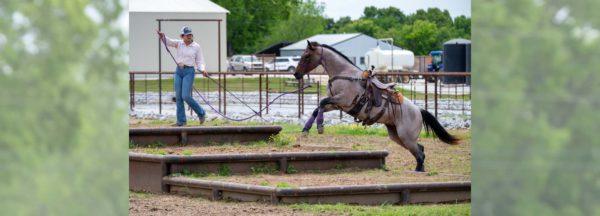
Having obstacles to work your horse over keeps training sessions fun and interesting for you and him. Plus, it allows you to work on practical skills you’ll need when you’re out exploring trails.
If you’ve got a set budget to work with or only a limited area in which to build a course, there are six obstacles that’ll get you the most bang for your training. The first obstacle I recommend is a log circle, the second is a small gully, the third is a curtain, all of which we’ve covered in previous tips, and the fourth is a staircase.
Exposes: How well your horse negotiates changes of elevations at a walk and trot. The staircase gets the horse confident about jumping up and down different heights on the go. While you’re working over this obstacle, he’ll never be quite sure what you’re going to ask him to do next. It teaches him to think on the go and builds his confidence. Once a horse gets comfortable with an obstacle, he’ll often tune his handler out and just go through the motions. This obstacle will keep him tuned in to you and paying attention to where he’s placing his feet.
Because of the varying heights of the tiers, the staircase is also an excellent obstacle to use to get the horse confident about listening to you from different angles. You can work beside him on the ground, be up above his eye level or be at a position in between. You’d be surprised at how well your horse will listen to you and how confident he is when you’re on the ground level with him, but when you get up above his eye, or change the angle from which you cue him, initially, he’ll often use the reactive side of his brain and be confused. You should be able to direct your horse from any position.

Dimensions: My staircase is 31 feet in length and made up of three tiers that are each 12 feet wide and 10 feet and 4 inches long. Each tier is reinforced with treated lumber so that dirt doesn’t fall away as horses move all around the obstacle. The first tier is 2 feet high; the second tier is 3 feet high; and the third tier is 4 feet high. On one side of the highest tier, I fashioned a sloping mound so that we could send horses up to the highest tier without having to ask them to jump up to it.
When you’re making your staircase obstacle, be sure the tiers are sturdy and won’t give away when your horse jumps down them or up them.
Practical Application: While you’re working over this obstacle, your horse will never be quite sure what you’re going to ask him to do next. It teaches him to think on the go and trust in you—both of which are handy skills for any trail horse to have.
Looking for more training tips? Check out the No Worries Club. Have a training question? Send it to us at [email protected].
