Training Tip: Practice Handling a Spooky Horse in a Controlled Environment
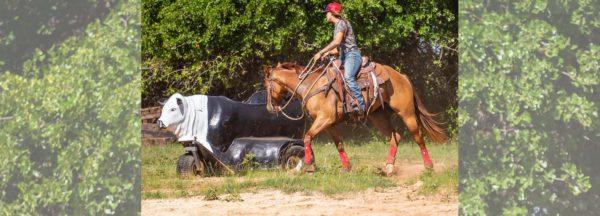
Knowing how to handle when your horse spooks and actually getting in the saddle and doing it are two separate things. If you want to get good at handling a spook, you have to put yourself and your horse in the situation to practice. You do that by introducing your horse to as many spooky objects as you can. This is a constant in our training program. Whether it be a stack of wooden pallets, discarded machinery parts, broken wheelbarrows— whatever junk you have lying around your property—it can be a great training tool!
Trot your horse in a circle around the spooky object, or if you’re not able to circle the object, circle in front of it. Every one-and-half circles, reverse directions by turning your horse in toward the object and doing a little rollback. Then continue to circle the object in the opposite direction.
Hustling your horse’s feet around the object and changing directions will get him to use the thinking side of his brain. Rather than focusing on his fear of the object, he’ll have to pay attention to you and think about how he’s placing his feet.
As your horse becomes more and more focused on circling and rolling back in toward the object, he’ll naturally get closer to it. Every time he turns in toward the object, he’ll get a step or two closer to it. Always turn the horse in toward the object, using your outside leg to drive his front end through the turn. If you turn him away from it, the negative energy from the object will drive him farther away from what he’s afraid of.
Before long, the horse will be circling and turning right in front of the object. When you can feel that he’s got his attention on you and isn’t worried about the spooky object, let him rest next to it on a loose rein. At this point, the horse will be huffing and puffing a little bit and looking for a rest and will willingly take you up on your offer to stand quietly beside the scary object. If he wants to investigate it (smell it, paw at it, etc.), let him. While he’s resting next to the object, rub all over him. Make him feel comfortable for standing next to the object.
While you can’t possibly introduce your horse to every single object he’ll ever encounter in his life, what you can do is practice so that when the situation does occur, you both can confidently work through the situation. If you’re always consistent about immediately putting the horse’s feet to work and circling him around the object until he’s using the thinking side of his brain and is confident enough to stand next to it, it’ll take you less and less time to go through that process with each object.
You’ll also find that the more you introduce your horse to spooky objects and use the steps I described to work him around them and get him to use the thinking side of his brain, the less he’ll actually spook. Even if he’s never seen an object before, he’ll be less likely to use the reactive side of his brain and panic. As soon as you feel the slightest bit of nervousness from him, you’ll direct his feet. You’ll take control of the situation and be a confident leader. Your horse will learn to trust you because you get him safely out of situations in which he’s scared.
Have a horsemanship question or looking for more training tips? Check out the No Worries Club.
